The Antidefuturing OS is a product of my PhD research into finding new ways to design interactions with complex, algorithmic systems while also acknowledging our entanglement with technology and how their harms are unevenly distributed in both temporal and societal ways.
Based on the structure of the Linux Operating System and Open Source Software models, the AntidefuturingOS is intended as a modular and customisable method for assembling tactics and strategies for dealing with general and specific issues with socio-technological entanglement. It resists the rigidity of a manifesto and instead presents itself as an infinitely rearrangeable and contestable library of tactics and practices that can be utilised in areas beyond its original intent.
Utilising Chantal Mouffe’s concept of critical consensus1, Derrida’s democracy to come2, and values of collaborative design approaches, the OS supports an ongoing argument and reconfiguration about what its values are and how it can be applied. It assumes that there are no solutionist or specific answers to society’s problems with technology, but rather maintains an openness to itself and in how we can work with technology and live with the artificial with sustainment.
It’s fundamental intent is to keep our futures open, and to ensure that society has the means to have agency in how technology is used and resist the defuturing of choice.
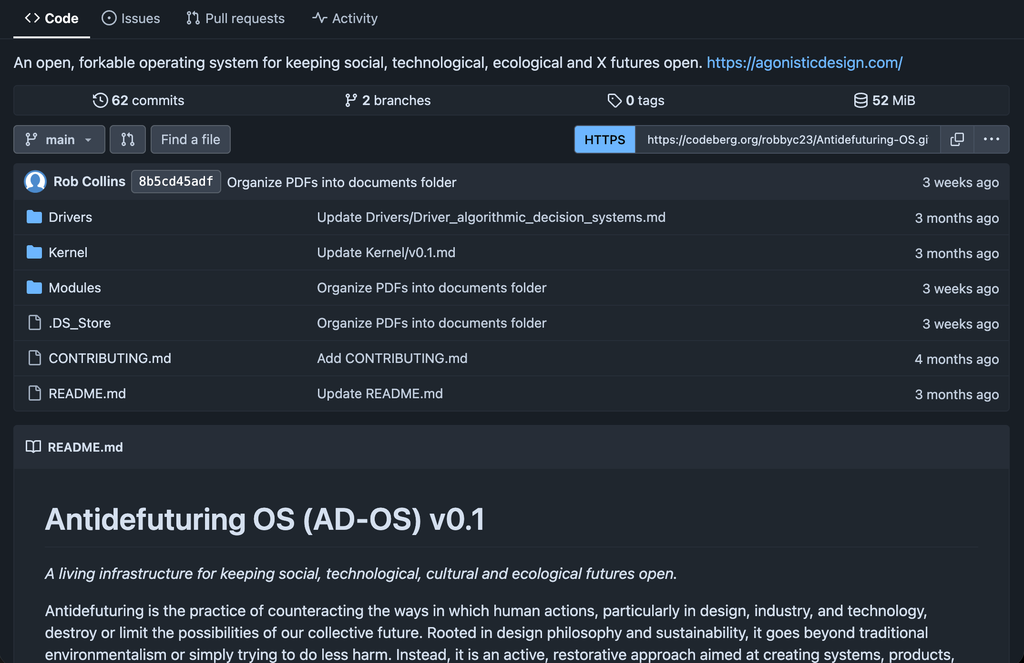
The AntidefuturingOS comprises of:
- Kernel: A fundamental set of values that are at the core of Antidefuturing.
- Drivers: Documents that translate the values of the Kernel into specific disciplines and areas of concern.
- Modules: Collections of practices and tactics that form a library that can be recombined into strategies for contestation.
The AntidefuturingOS is an ongoing consensus-based and agonistic platform that will be workshopped, split and reused as required and in response to emerging issues in the Anthropocene.